Digital advertising agency

New attention, planned properly.

Baru means new. We find new attention for businesses — then plan, buy and refine the advertising that earns it, across search, social, display and video.

Strategy · Media planning & buying · PPC · Programmatic · Search visibility

Where a mixed budget tends to sit — illustrative split

Demand capture Demand creation Retention

Paid search
Paid social
Display & programmatic
Online video
Retargeting

Illustrative only — not a recommendation or a client result Your split is decided by objective, margin and demand

Channels we plan and buy

The channels we buy

01

Paid search

Capturing demand that already exists, at the moment someone is looking for it.

02

Paid social

Reaching people by who they are and what they do, before they start searching.

03

Display & programmatic

Buying attention across the open web with control over placement and frequency.

04

Online video

Explaining something complicated, or building recognition ahead of the decision.

05

Retargeting

Finishing conversations with people who already showed genuine interest.

06

Search visibility

The organic side of the result page, so paid budget is not carrying every click.

01 Our approach

Advertising is a budget decision before it is a creative one

Most campaigns do not fail because the ads were bad. They fail because money went to the wrong audience, in the wrong channel, at the wrong point in the decision — and nobody noticed for a quarter. Our job is to make those choices deliberately, write down why, and check them against what actually happened.

PRINCIPLE 01

Plan before you buy

Every campaign starts with a written plan: who we are trying to reach, what we want them to do, which channels can realistically do that, and what we will accept as evidence that it worked. Buying starts after that is agreed, not before.

PRINCIPLE 02

Spend against intent

Volume is easy to buy and usually misleading. We weight budget toward audiences and moments that show genuine purchase intent, and treat broad reach as something that must earn its place rather than something to start with.

PRINCIPLE 03

Report what you would act on

A report should tell you what changed, what we did about it and what we are doing next. If a number would not alter a decision, it belongs in the appendix, not on the first page.

02 Services

Eight disciplines, assembled around one objective

We do not sell packages. An engagement is built from the disciplines your situation calls for — sometimes that is a full media programme, sometimes it is one account rebuilt properly.

01

Digital Advertising Strategy

Foundation

The decisions that everything else inherits: which objective advertising is being asked to serve, which audiences are worth paying for, how much of the budget belongs to capturing existing demand versus creating new demand, and what the measurement will be.

Businesses need this when spend has grown faster than the thinking behind it — several active channels, no shared view of what each one is for.

How it runs

  1. Commercial and margin context
  2. Demand and competitor review
  3. Channel role definition
  4. Budget shape and measurement plan

Supports: clear allocation, fewer overlapping campaigns

02

Audience Research & Targeting

Foundation

Defining who is actually worth reaching, then translating that into the targeting each platform can execute: search intent, interest and behaviour signals, customer-match segments, lookalike modelling and exclusion rules.

The exclusions matter as much as the inclusions. A large part of wasted spend is advertising to people who were never going to buy, or who already have.

How it runs

  1. Segment definition and sizing
  2. Intent and signal mapping
  3. Platform targeting build
  4. Exclusion and suppression rules

Supports: lower waste, better qualified traffic

03

Media Planning & Buying

Core

Turning strategy into a schedule: which channels run, when they run, what each is allocated, how frequency is controlled where they overlap, and what the buying approach is on each platform.

Planning is where seasonality, sales cycles and production lead times get reconciled with the budget — before anyone commits money to a platform.

How it runs

  1. Flight plan and phasing
  2. Allocation across channels
  3. Buying setup and pacing
  4. In-flight budget management

Supports: predictable pacing, controlled frequency

04

Paid Search & PPC Management

Core

Day-to-day management of search campaigns: account structure, keyword and query management, match-type discipline, negative keyword work, bidding strategy, ad copy testing and the landing pages those clicks arrive on.

Search rewards maintenance. Most accounts we review are not broken so much as unattended — query drift, stale copy and automation left to run without constraints.

How it runs

  1. Account and structure audit
  2. Query, match and negative work
  3. Bidding and budget controls
  4. Copy and landing page testing

Supports: cost control on high-intent traffic

05

Display, Video & Programmatic

Core

Buying attention beyond the search result: display inventory, online video and programmatic placements, with attention paid to where ads actually appear, how often one person sees them, and which inventory is excluded.

Used deliberately, this is how a business becomes familiar before the search happens. Used carelessly, it is the fastest way to spend a budget on impressions nobody noticed.

How it runs

  1. Inventory and placement strategy
  2. Frequency and exclusion controls
  3. Format and creative specification
  4. Quality and viewability review

Supports: recognition ahead of the decision

06

Advertising Creative Strategy

Message

Deciding what the advertising should say to each audience, and in what form. Message territories, offer framing, format requirements per placement, and a testing structure so the message is the variable being tested rather than everything at once.

We work with your designers or production partners, and we write the brief they need rather than handing over a vague instruction to make something eye-catching.

How it runs

  1. Message territory development
  2. Creative brief and format matrix
  3. Variant structure for testing
  4. Read-out and iteration

Supports: messages chosen on evidence

07

Campaign Analytics & Optimisation

Evidence

Making the results legible and then acting on them: conversion tracking that reflects real business events, sensible attribution expectations, channel contribution analysis, and the landing page and funnel work that turns clicks into enquiries.

This is also where we are honest about measurement limits. Attribution is an estimate, and treating it as fact is how budgets get moved for bad reasons.

How it runs

  1. Tracking and event validation
  2. Reporting structure setup
  3. Contribution and pacing review
  4. Landing page and funnel fixes

Supports: decisions grounded in evidence

08

SEO & Search Visibility

Compounding

The organic half of the search result. Technical health, page structure, content that matches what people are actually searching for, and the internal linking that makes a site legible to a search engine.

We treat it as the long-term counterweight to paid search: it takes longer to move, and it keeps producing when a campaign pauses.

How it runs

  1. Technical and indexation review
  2. Query and intent mapping
  3. Page and content priorities
  4. Ongoing measurement

Supports: reduced dependence on paid clicks

03 Planning

A quarter, laid out before anyone spends

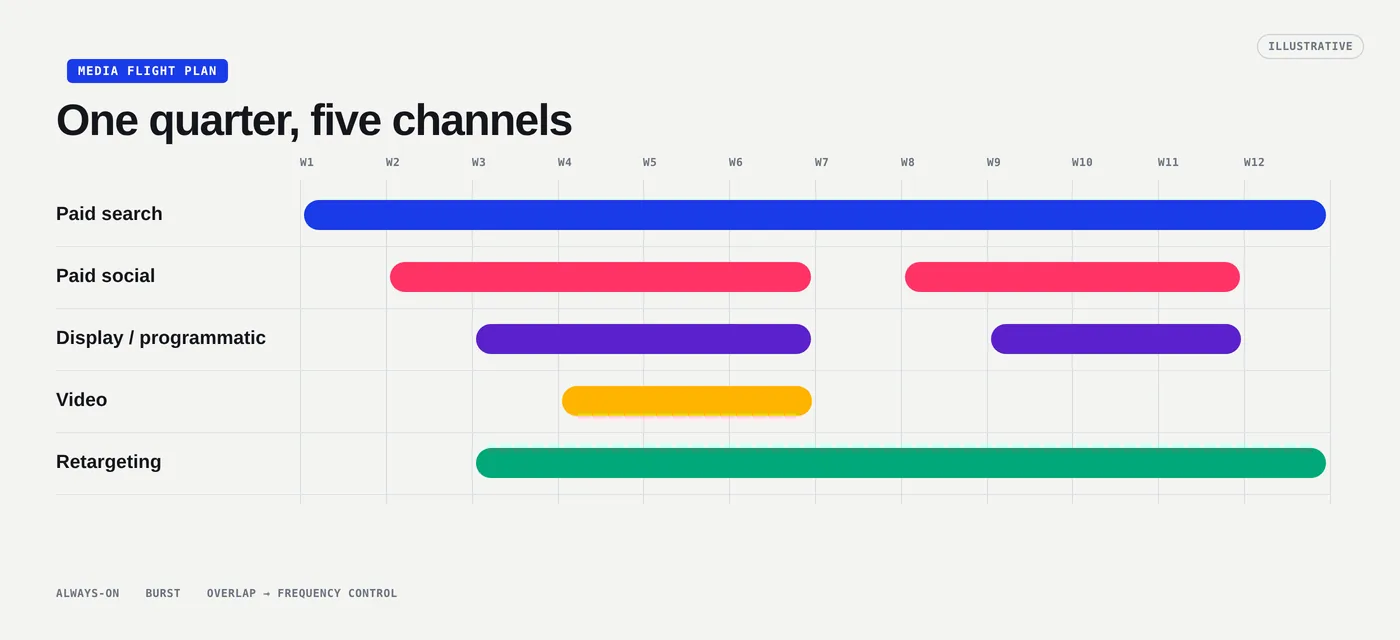
A flight plan makes the trade-offs visible. You can see what is always on, what bursts, where channels overlap, and which weeks are carrying the most weight — while there is still time to change it.

Baru Ads quarterly media flight plan: paid search running always-on, paid social and display in bursts, video and retargeting scheduled across twelve weeks

Swipe the panel to see all of it

Phasing is a decision, not a leftover

Deciding when a channel runs is as consequential as deciding whether it runs at all. Sustained channels hold a baseline; bursts create pressure around a launch or a season; overlaps need frequency control so the same person is not paid for five times in a week.

  • Always-on channels that hold a floor of demand capture
  • Bursts timed to launches, seasons and sales cycles
  • Frequency managed where channels overlap on the same audience
  • Budget pacing checked weekly rather than discovered at month end

Example schedule — illustrative, not a client plan

Phase one

Frame

Understand the commercial objective, the margin, the sales process and what a useful customer is actually worth before discussing channels.

Output: objective & measurement agreement

Phase two

Plan

Build the audience definition, channel roles, flight plan and budget allocation, with the reasoning written down so it can be challenged.

Output: media plan & creative brief

Phase three

Launch

Build the accounts, verify tracking before traffic arrives, and start deliberately so early data is clean enough to learn from.

Output: live campaigns & verified tracking

Phase four

Refine

Read results against the plan, rebalance budget, retire what is not working, and feed what we learned back into the next cycle.

Output: monthly read-out & revised plan

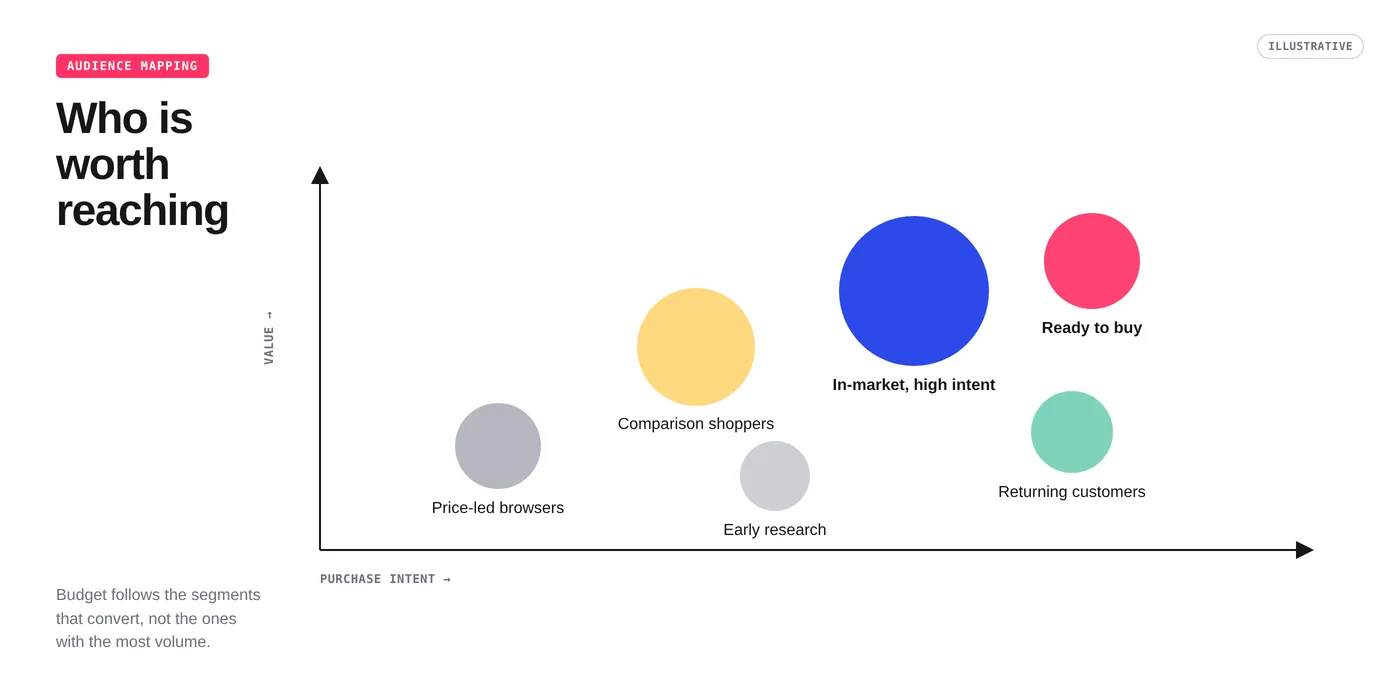
Baru Ads audience map plotting segments such as early research, comparison shoppers, in-market buyers and returning customers against purchase intent and value

Swipe the panel to see all of it

04 Audiences

Reach is cheap. The right reach is not.

Any platform will sell you scale. The useful question is which part of that scale is worth paying for — and most businesses have a small number of segments that justify the majority of the budget.

We map segments against two things that matter commercially: how close someone is to a purchase decision, and what that purchase is worth. Targeting, bidding and message all follow from where a segment sits.

  • Search intent read from the queries people actually use
  • Behavioural and interest signals matched to platform capability
  • Customer-match and lookalike modelling from your own data
  • Suppression of existing customers and unqualified traffic

Example segmentation — illustrative, not client data

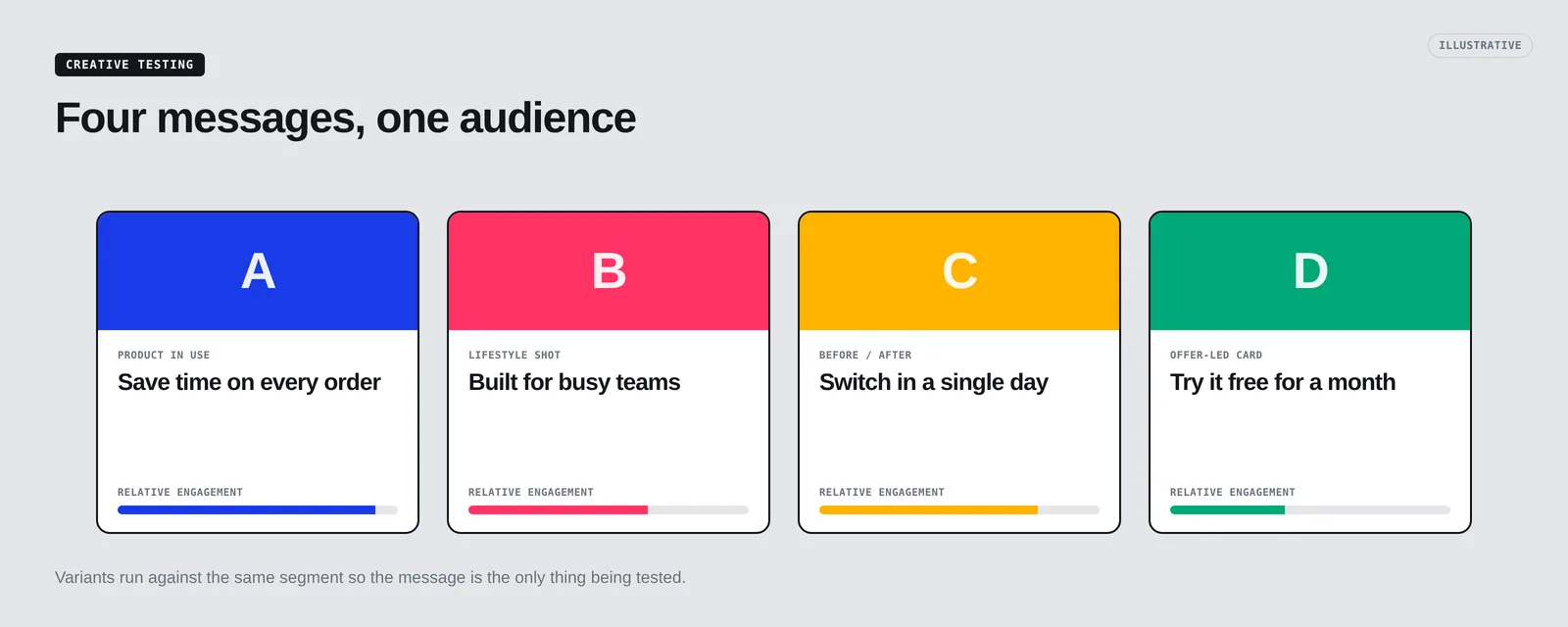
Baru Ads creative testing board showing four advertising message variants run against a single audience segment

Swipe the panel to see all of it

05 Creative strategy

Test the message, not everything at once

A campaign that changes the audience, the offer and the artwork in the same week has learned nothing by the end of it. We structure tests so one variable moves at a time and the result means something.

We are a strategy and media partner, not a production studio. We write the brief, define the formats each placement needs, and work with your designers or production partners to get it made.

  • Message territories developed per audience segment
  • Format matrix covering every placement being bought
  • Variant structure that isolates a single variable
  • Read-outs that say what to keep and what to retire

Example test structure — illustrative, not client data

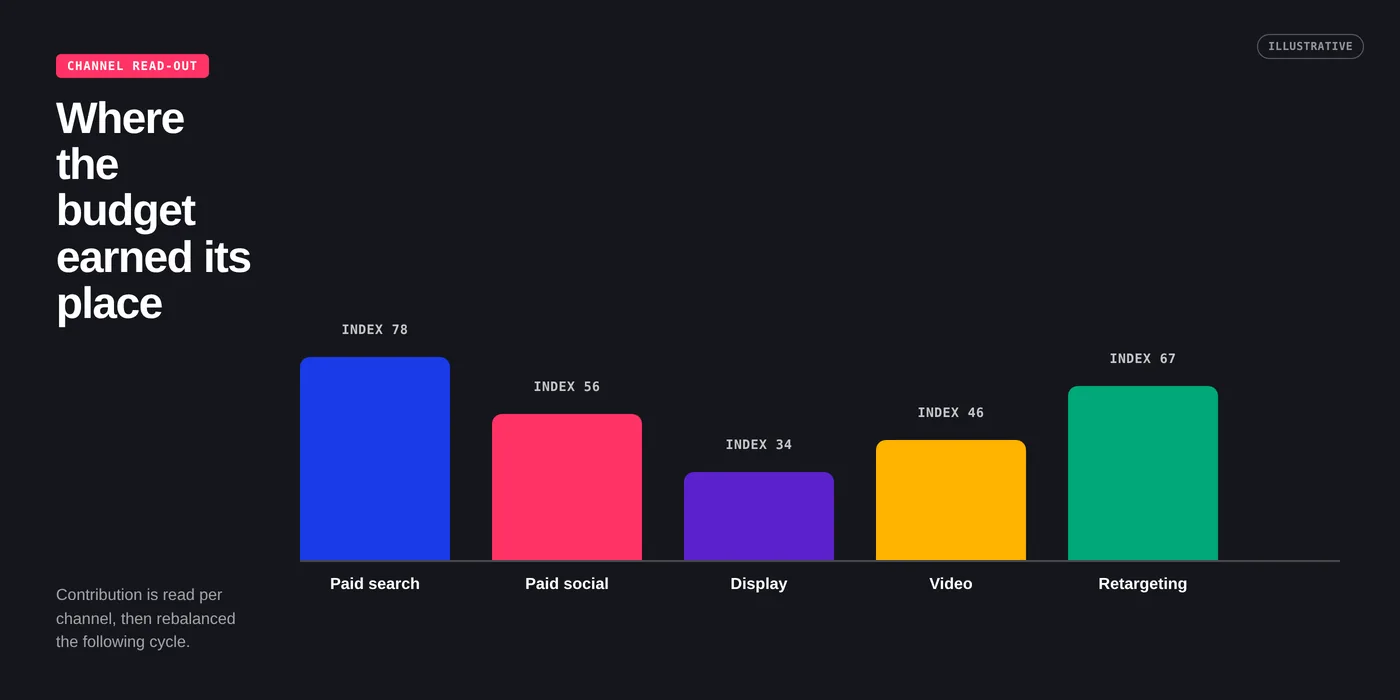
Baru Ads channel read-out comparing the relative contribution of paid search, paid social, display, video and retargeting

Swipe the panel to see all of it

06 Measurement

Reporting you could make a decision from

Reporting exists so budget can move for good reasons. Each cycle we look at what each channel contributed, where pacing drifted, which audiences and messages earned their place, and what we intend to change.

We are also clear about what the numbers cannot tell you. Attribution models estimate; platforms disagree with each other and with your own records. We present ranges and reasoning rather than false precision.

  • Conversion tracking tied to real business events, verified before launch
  • Channel contribution read in context rather than platform-reported in isolation
  • Pacing and budget variance reviewed weekly
  • A written note of what changed, why, and what happens next

Example read-out — illustrative, not client results

07 Working together

Three ways an engagement usually starts

Most conversations begin with one of these. Which one fits depends on whether the problem is the plan, the execution, or knowing whether either is any good.

Advisory & audit

A fixed-scope review of existing advertising: account structure, targeting, tracking accuracy, budget allocation and the gap between what is being measured and what matters. Ends with a prioritised set of recommendations you can act on with or without us.

Best when spend exists but nobody can explain the returns

Campaign engagement

A defined campaign planned, built and run end to end — a launch, a season, a new market or a new product line. Scoped with a start and a finish, a flight plan and an agreed measurement framework.

Best when there is a specific thing to go to market with

Ongoing media management

Continuous planning, buying, optimisation and reporting across the channel mix, with a monthly cycle of read-out and replanning. The model most businesses move to once advertising becomes a standing part of the operation.

Best when advertising is a permanent line in the budget

08 Questions

The things worth asking before you hire anyone

Including the one most agencies answer badly: whether results can be promised in advance.

No. Anyone who guarantees a specific cost per acquisition or return before seeing your data is guessing, and the guess is usually designed to win the pitch.

Advertising results depend on your margins, your market, what competitors are willing to pay for the same attention, your conversion experience and the quality of the creative. Several of those are outside our control, and auction prices move independently of anything either of us does.

What we will do is set expectations from your actual data once we have seen it, say plainly when a target looks unrealistic, and show our reasoning either way.

There is no fixed minimum, but there is a practical one. A budget has to be large enough to gather meaningful data in a reasonable period, or optimisation is just noise-chasing, and it has to be large enough that management fees do not consume the benefit.

If your budget is below the point where we would add value, we will say so in the first conversation and suggest what to do instead. That is a cheaper answer for both of us than finding out six months in.

You do. Accounts are set up under your own business entity wherever the platform allows it, and we work inside them with the access level the work requires.

If an engagement ends, the accounts, the historical data and the campaign assets stay with you. There is no benefit to us in holding a client through account ownership, and arrangements that do are worth avoiding generally.

Data arrives immediately; useful information takes longer. Early numbers are volatile, platform algorithms need a learning period, and small conversion volumes produce differences that look real and are not.

How long depends on your conversion volume rather than the calendar. A business with hundreds of monthly conversions learns far faster than one with a dozen, and we will say at the outset roughly when we expect to be able to draw conclusions.

We handle creative strategy: what the advertising should say, to whom, in what format, and how variants are structured so a test produces an answer. We write the brief.

Production is done by your in-house designers, your existing production partner, or a studio we work alongside. We would rather plug into a team that already knows your brand than insist on owning every part of the process.

Frequently. In-house teams often have the brand knowledge and the content capability but not the time or the platform depth for daily media management — or the reverse.

We agree who owns what at the start: which decisions sit with us, which need sign-off, and how work moves between the two sides. Ambiguity there causes more problems than any technical issue.

By scope. An audit or a defined campaign is quoted as a fixed fee; ongoing management is a monthly fee based on the channels covered and the work the account realistically needs.

We quote after a scoping conversation rather than from a price list, because the same budget can mean very different amounts of work depending on the number of channels, markets and campaigns involved. Media spend is paid by you to the platforms directly.

To have a useful first conversation: what you sell, who tends to buy it, what you are currently doing in advertising, and what you want the next year to look like.

To begin work: access to existing ad accounts and analytics, a sense of your margins or what a customer is worth, and a named person on your side who can make decisions. The last one matters more than people expect.

09 Contact

Tell us what you are trying to sell, and to whom

Send a short description of the business and the objective. We will reply with an honest read on whether advertising is the right lever, which channels we would look at first, and whether we are the right people for it.

Or email us directly

[email protected]
  1. 01You describe the business, the objective and what is running now.
  2. 02We review what is public, and ask for account access only if it becomes relevant.
  3. 03You get a written view on approach, priorities and fit — no obligation either way.
This field is required.
Enter a valid email address.
Please check this field.
Please tell us a little about the campaign.

Fields marked * are required. We use what you send only to reply to your enquiry — see the Privacy Policy.